The interaction-menu options at an arsenal crate or ammo box in Conflict mode, the loadout screen's radio backpack and field jacket tooltips, and the M22 binoculars with how to range a target in mils, in Russian, for quick lookup while playing. Tap the button to hear it.
0.90x
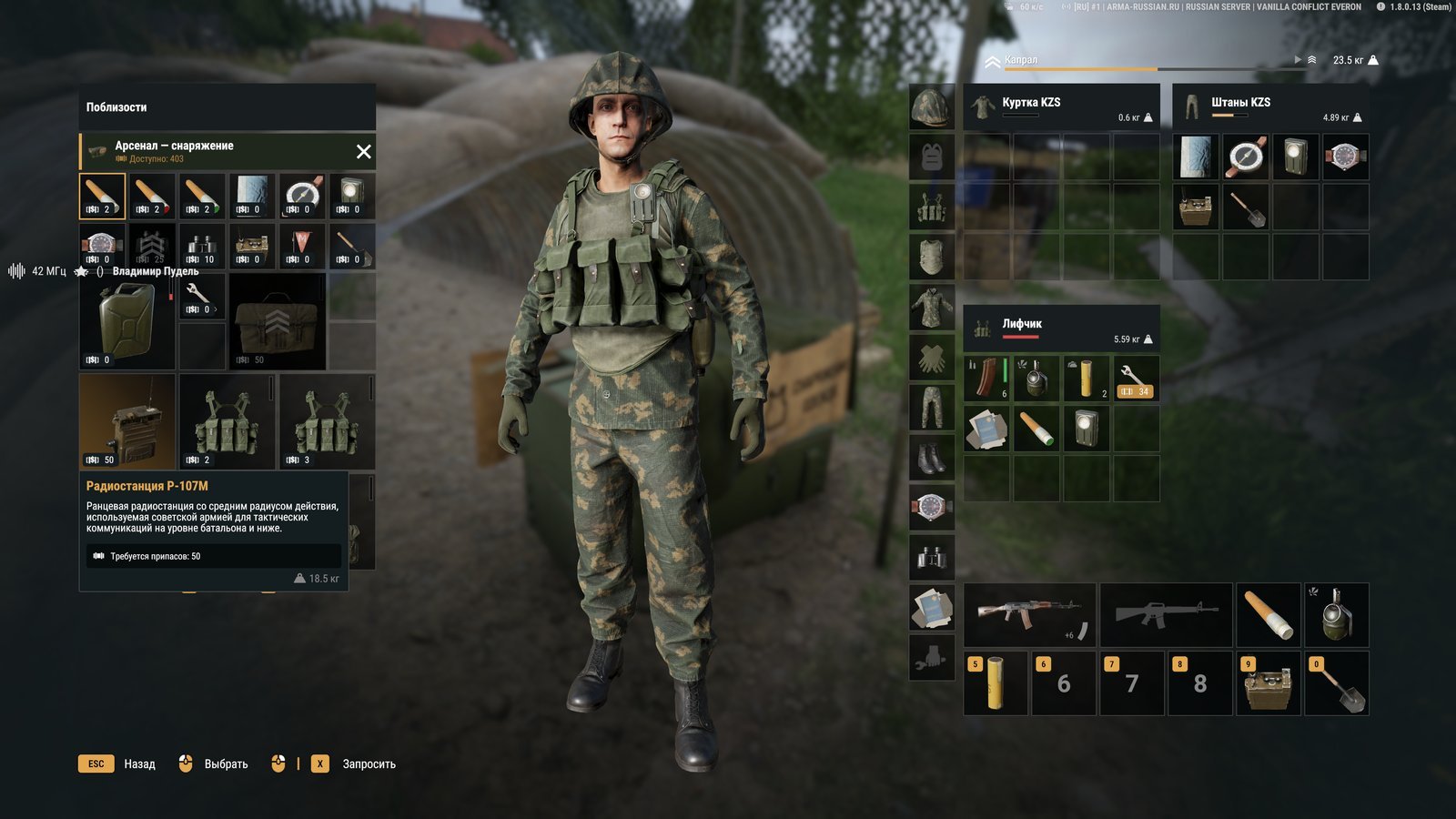
Loadout: Radio Backpack
Radio Backpack Tooltip
Радиоста́нция Р-107М
R-107M Radio Set
NOMРадиоста́нция · Dictionary радиоста́нция (fem., "radio set, radio station"); Head noun, from ра́дио and ста́нция.
Р-107М is the set's Soviet designation: Р for радиоста́нция and М for модернизи́рованная ("modernised"). Read aloud as letters and numbers: эр-сто́-семь-э́м.
The game files this item under Рюкза́к ради́ста ("radio operator's backpack"), its radio-backpack slot. In Conflict, a deployed radio backpack becomes a spawn point for your side.
Ра́нцеваярадиоста́нция со сре́днимра́диусомде́йствия, испо́льзуемаясове́тскойа́рмией для такти́ческихкоммуника́ций на у́ровнебатальо́на и ни́же
A mid-range manpack radio set, used by the Soviet army for tactical communications at battalion level and below.
NOMрадиоста́нция · Dictionary радиоста́нция (fem., "radio set"); Head noun of the whole description.
NOMРа́нцевая ("manpack, carried on the back") · Agrees with радиоста́нция, nominative feminine. From ра́нец ("knapsack").
INSра́диусом · Dictionary ра́диус (masc., "radius"); After со ("with"), which takes the instrumental. Со is с with an added о before a consonant cluster, as in со сре́дним.
INSсре́дним ("medium") · Agrees with ра́диусом, instrumental masculine.
GENде́йствия · Dictionary де́йствие (neut., "action"); Genitive, modifying ра́диусом: ра́диус де́йствия, "radius of action", is the ordinary way to say a radio's range.
NOMиспо́льзуемая ("used") · Present passive participle of испо́льзовать, agreeing with радиоста́нция.
INSа́рмией · Dictionary а́рмия (fem., "army"); The agent of a passive participle goes in the instrumental: "used by the army".
INSсове́тской ("Soviet") · Agrees with а́рмией, instrumental feminine.
GENкоммуника́ций · Dictionary коммуника́ция (fem., "communication"); Genitive plural after для ("for"), which always takes the genitive.
GENтакти́ческих ("tactical") · Agrees with коммуника́ций, genitive plural.
PREPу́ровне · Dictionary у́ровень (masc., "level"); After на, prepositional: на у́ровне, "at the level (of)". The е of у́ровень drops out when an ending is added.
The Russian text says батальо́н (battalion), while the game's English version of the same tooltip says company-level. The translation here follows the Russian.
Тре́буетсяприпа́сов: 50
Supply cost: 50 (literally "Of supplies is required: 50")
тре́буется · Third person present of тре́боваться, the -ся form of тре́бовать ("to demand").
GENприпа́сов · Dictionary припа́с (masc., "supply, stock"); Genitive plural, because it is counted by the number 50 (five and up take the genitive plural), placed before the colon.
Припа́сы (supplies) are Conflict's building and equipment currency, the same number shown on every build card.
Восемна́дцать с полови́нойкилогра́ммов
18.5 kilograms (shown as 18.5 кг on the tooltip)
NOMВосемна́дцать · Dictionary восемна́дцать (numeral, "eighteen"); The number, nominative. A cardinal of five and up governs the counted noun in the genitive plural.
GENкилогра́ммов · Dictionary килогра́мм (masc., "kilogram"); Genitive plural, counted by восемна́дцать (five and up take the genitive plural).
INSполови́ной · Dictionary полови́на (fem., "half"); After с ("with"), instrumental: восемна́дцать с полови́ной, "eighteen and a half".
The tooltip shows 18.5 кг. Кг is short for килогра́мм, and the audio says the full words. Russian normally writes a decimal with a comma (18,5); the game uses a point.
Read as a decimal instead, the noun is genitive singular: восемна́дцать и пять деся́тых килогра́мма.
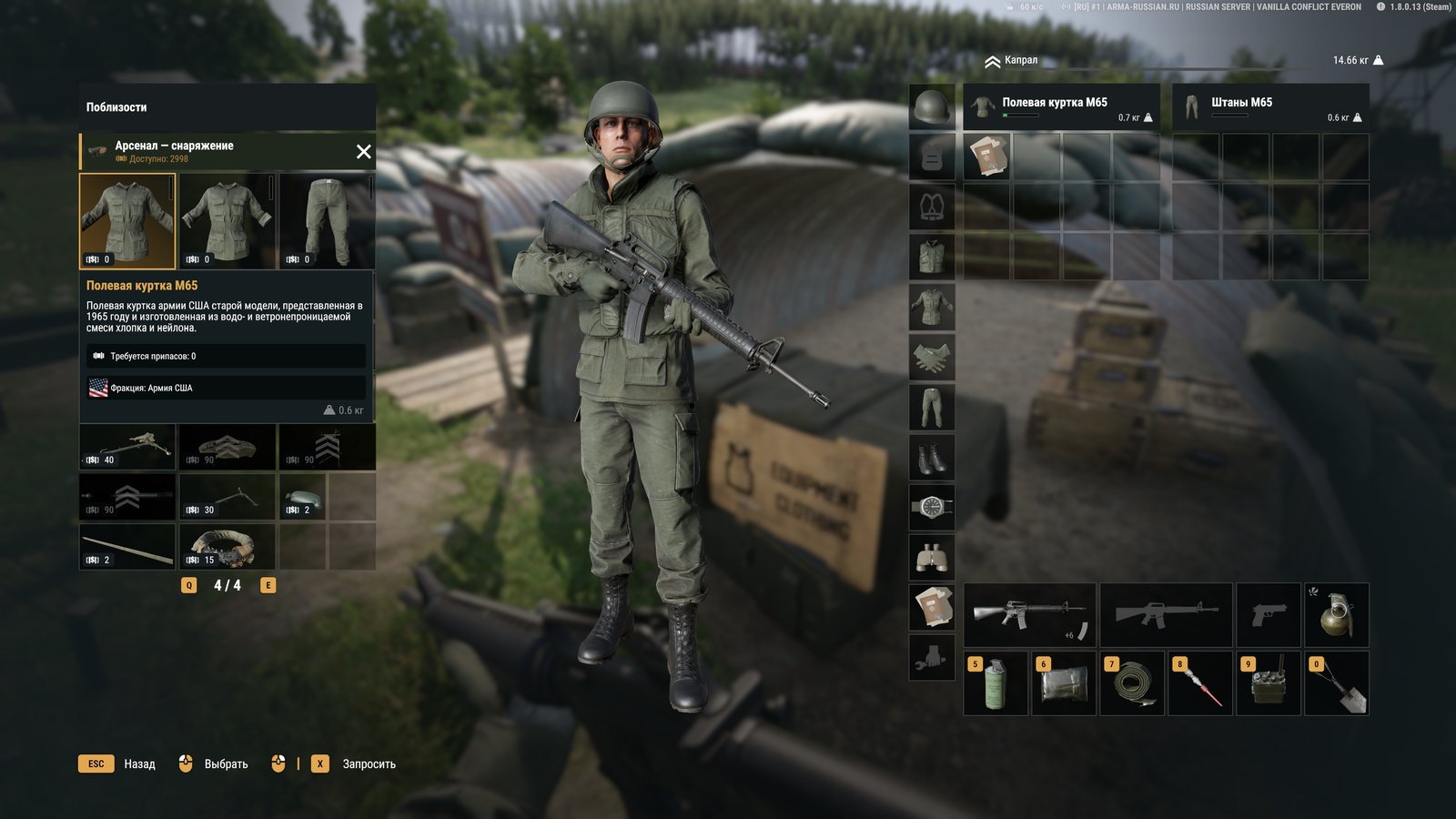
Loadout: Field Jacket
Field Jacket Tooltip
Полева́яку́ртка M65
M65 Field Jacket
NOMку́ртка · Dictionary ку́ртка (fem., "jacket"); Head noun, nominative.
NOMПолева́я ("field") · Agrees with ку́ртка, nominative feminine. From по́ле ("field"), as in полева́я фо́рма, "field uniform".
M65 is the American model designation, for the year it was introduced, written in Latin letters as in the game. Players read it as эм шестьдеся́т пять.
Полева́яку́рткаа́рмииСШАста́роймоде́ли, предста́вленная в ты́сяча девятьсо́т шестьдеся́т пя́томгоду́ и изгото́вленная из водо- и ветронепроница́емойсме́сихло́пка и нейло́на
An older-design US Army field jacket, introduced in 1965 and made from a water- and wind-resistant blend of cotton and nylon. (The tooltip writes the year as 1965.)
NOMку́ртка · Dictionary ку́ртка (fem., "jacket"); Head noun of the whole description.
NOMПолева́я ("field") · Agrees with ку́ртка, nominative feminine.
GENа́рмии · Dictionary а́рмия (fem., "army"); Genitive, "of the army": ку́ртка а́рмии США, "a US Army jacket".
GENСША · Short for Соединённые Шта́ты Аме́рики ("United States of America"), read as letters: сэ-шэ-а́; Genitive, "of the USA", modifying а́рмии. An abbreviation like this never declines, so it looks the same in every case.
GENмоде́ли · Dictionary моде́ль (fem., "model, design"); Genitive of description: ку́ртка ста́рой моде́ли, "a jacket of an old design".
GENста́рой ("old") · Agrees with моде́ли, genitive feminine.
NOMпредста́вленная ("introduced") · Past passive participle of предста́вить (pf., "to present, introduce"), agreeing with ку́ртка.
PREPгоду́ · Dictionary год (masc., "year"); After в, prepositional. Год is one of the masculine nouns with a special stressed -у́ ending for place and time: в году́, never в го́де.
PREPпя́том ("fifth") · Ordinal пя́тый, agreeing with году́, prepositional masculine. In a compound ordinal only the last word declines, so ты́сяча девятьсо́т шестьдеся́т stays unchanged. The tooltip shows the digits 1965; the audio reads the year in full.
NOMизгото́вленная ("made, manufactured") · Past passive participle of изгото́вить (pf., "to make, manufacture"), agreeing with ку́ртка.
GENсме́си · Dictionary смесь (fem., "mixture, blend"); After из ("from, out of"), which always takes the genitive.
GENветронепроница́емой ("windproof") · Agrees with сме́си, genitive feminine. Built from ве́тер ("wind") + не + проница́емый ("penetrable").
Водо- is the first half of водонепроница́емой ("waterproof"). When two compounds share a second half, Russian writes it once and leaves a hyphen on the first word, just like English "water- and windproof".
GENхло́пка · Dictionary хло́пок (masc., "cotton"); Genitive, "of cotton", describing the blend. The о drops out when an ending is added: хло́пок, хло́пка.
GENнейло́на · Dictionary нейло́н (masc., "nylon"); Genitive, joined to хло́пка by и.
Тре́буетсяприпа́сов: 0
Supply cost: 0 (literally "Of supplies is required: 0")
тре́буется · Third person present of тре́боваться, the -ся form of тре́бовать ("to demand").
GENприпа́сов · Dictionary припа́с (masc., "supply, stock"); Genitive plural. Ноль ("zero") governs the counted noun exactly like five and up do: ноль припа́сов.
Clothing is free to take from the arsenal, unlike the R-107M radio on the same screen, which costs 50.
Фра́кция: А́рмияСША
Faction: US Army
NOMФра́кция · Dictionary фра́кция (fem., "faction"); The label before the colon, nominative.
NOMА́рмия · Dictionary а́рмия (fem., "army"); The value after the colon, also nominative.
GENСША · Short for Соединённые Шта́ты Аме́рики ("United States of America"), read as letters: сэ-шэ-а́; Genitive, "army of the USA". Being an abbreviation, it never changes form.
The flag beside this line on screen shows which side the item belongs to; each faction's arsenal only stocks its own gear.
Нольце́лыхшестьдеся́тыхкилогра́мма
0.6 kilograms (shown as 0.6 кг on the tooltip)
NOMНоль · Dictionary ноль (masc., "zero"); The whole-number part, nominative.
GENце́лых · From це́лая ("whole"), genitive plural after ноль; Russian reads a decimal as so many wholes and so many tenths. After одна́ it would be одна́ це́лая.
NOMшесть · Dictionary шесть (numeral, "six"); The number of tenths, nominative.
GENдеся́тых · From деся́тая ("tenth", feminine to agree with an understood часть, "part"); Genitive plural, counted by шесть.
GENкилогра́мма · Dictionary килогра́мм (masc., "kilogram"); Genitive SINGULAR: after a decimal fraction the noun is always genitive singular, however large the number. Compare the radio's восемна́дцать с полови́ной килогра́ммов.
Кг is short for килогра́мм, and the audio says the full words. Russian normally writes a decimal with a comma (0,6); the game uses a point. In quick speech people often just say ноль шесть.
Arsenal & Ammo Crate
Откры́тьарсена́л
Open Arsenal
откры́ть · Infinitive (pf., "to open"); Used bare as an on-screen menu-option prompt.
ACCарсена́л · Dictionary арсена́л (masc.); Direct object of откры́ть, accusative (inanimate, same as nominative).
Сохрани́тьэкипиро́вку
Save Loadout (Equipment)
сохрани́ть · Infinitive (pf., "to save").
ACCэкипиро́вку · Dictionary экипиро́вка (fem., "loadout/equipment"); Direct object of сохрани́ть, accusative.
Взятьбоеприпа́сы для акти́вногоору́жия
Take Ammo for the Active Weapon
взять · Infinitive (pf., "to take").
ACCбоеприпа́сы · Dictionary боеприпа́с (masc.), plural; Direct object of взять, accusative plural (inanimate, same as nominative plural).
GENору́жия · Dictionary ору́жие (neut., "weapon"); Object of "для" (for), which always takes genitive.
GENакти́вного ("active") · Agrees with ору́жия, genitive singular.
Взятьбоеприпа́сы для подство́льногогранатомёта
Take Ammo for the Underbarrel Grenade Launcher
GENгранатомёта · Dictionary гранатомёт (masc., "grenade launcher"); Genitive after "для," same construction as the entry above.
GENподство́льного ("underbarrel-mounted") · Agrees with гранатомёта, genitive singular.
Взятьграна́ту
Take a Grenade
ACCграна́ту · Dictionary грана́та (fem.); Direct object of взять, accusative.
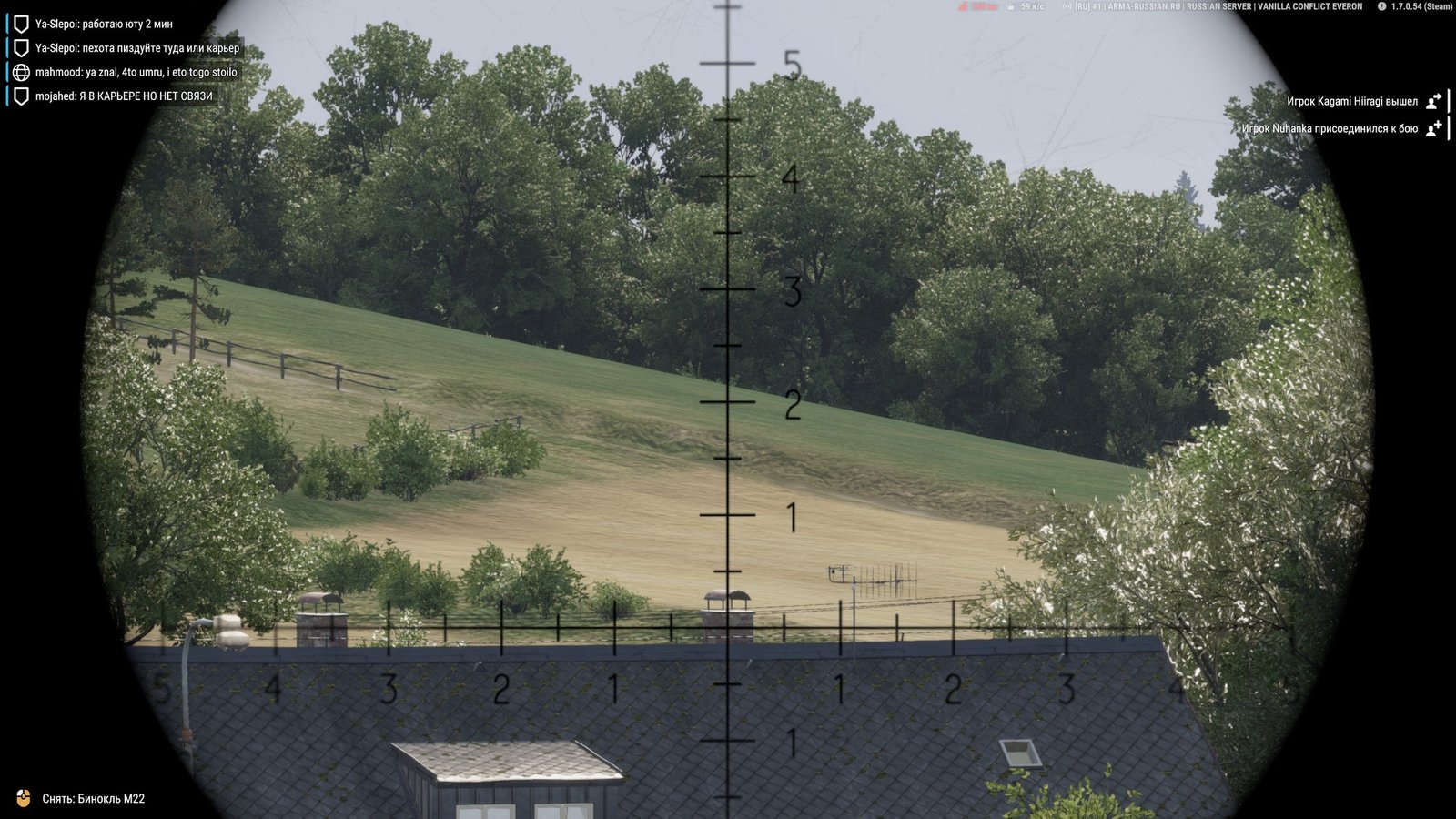
M22 Binocular Reticle
Optics & Equipment
Снять: Бино́кль M22
Doff: Binoculars M22
снять · Infinitive (pf., "to take off/doff").
NOMБино́кль · Dictionary бино́кль (masc.); Named as a label after the colon rather than inflected as the object of снять, the game's "Action: Item" menu format.
Бино́кль
Binoculars
Да́льность
Range / Distance
Дальноме́р
Rangefinder
Ты́сячная
Mil (angular unit)
NOMТы́сячная · Literally "the thousandth [one]," a substantivized adjective (fem.); The name for the angular "mil" unit taught in the range-card note below.
M22 Range Card
M22 Range Card. Mil Relation Method
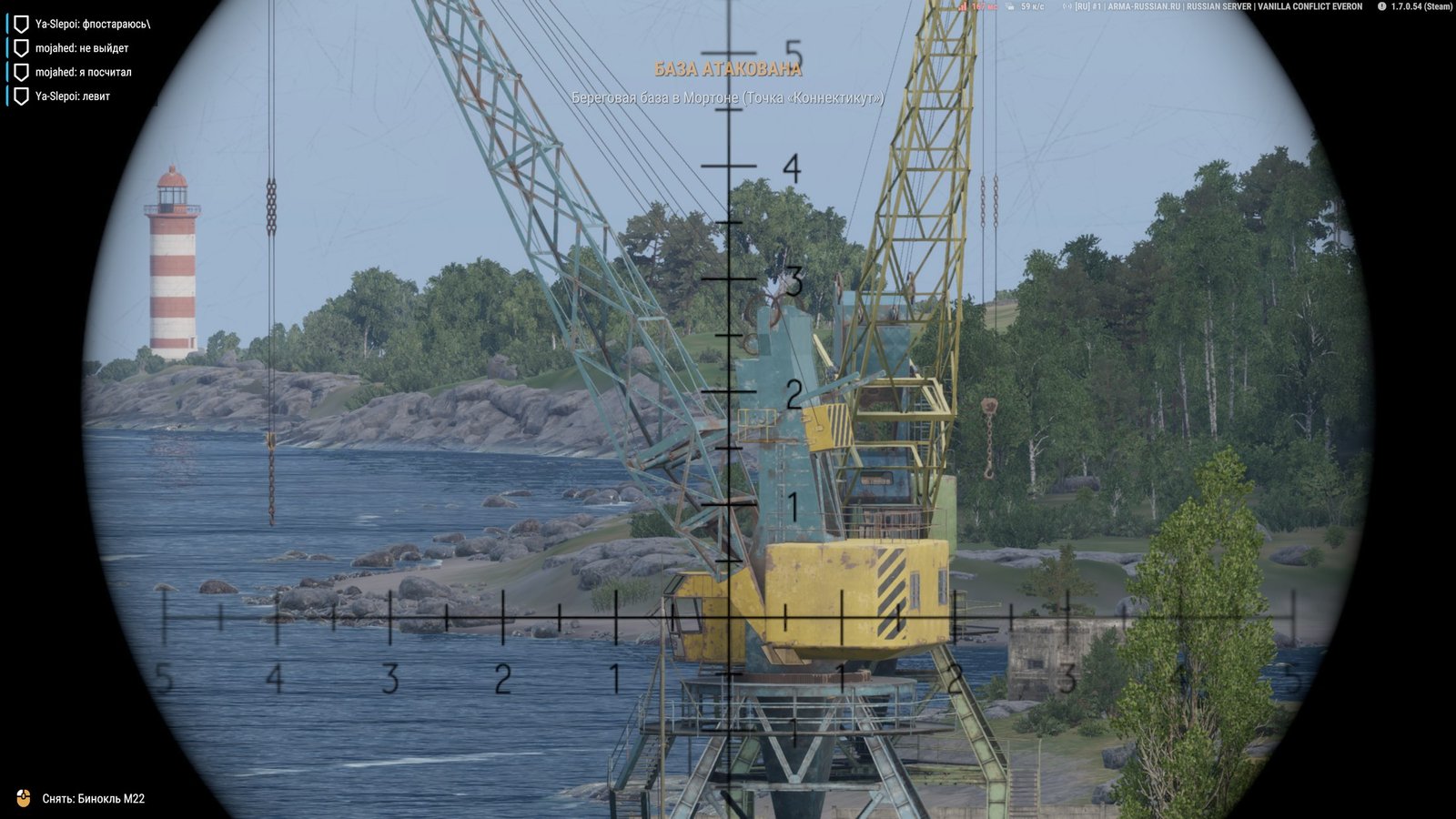
The M22 reticle is a ranging tool, not just an aiming aid. It's graduated in mils (Ты́сячные): each numbered mark is 10 mils, each small tick between them is 5 mils. The vertical scale measures a target's height (up to 50 mils); the horizontal scale measures width (40 mils left, 30 right).
1 mil = 1 meter of size at 1000 meters of distance. That relationship gives the ranging formula:
Distance (m) = real size (m) ÷ size in mils × 1000
Find the target's real-world size, measure how many mils it spans on the reticle, then plug into the formula. Worked examples:
A soldier (~1.8 m tall) spanning 10 mils → (1.8 / 10) × 1000 = 180 m
A soldier spanning 18 mils → 100 m. Spanning 6 mils → 300 m
A BTR (~7.5 m long) spanning 30 mils on the horizontal scale → 250 m (the standard in-game reference)
Ranging works best on objects with predictable dimensions: a standing person (~1.8 m), a vehicle, a doorway (~2 m), a power pole (~10 to 11 m). It's unreliable on things like chimneys or antennas, whose true size is a guess. Memorize one anchor, a soldier at the "1" mark (10 mils) ≈ 180 m, and estimate other distances from there.
Same reticle, ranging a dockyard crane during a "Ба́за атако́вана" (Base Attacked) alert.
Soviet binoculars/optics reference: pending a future update.