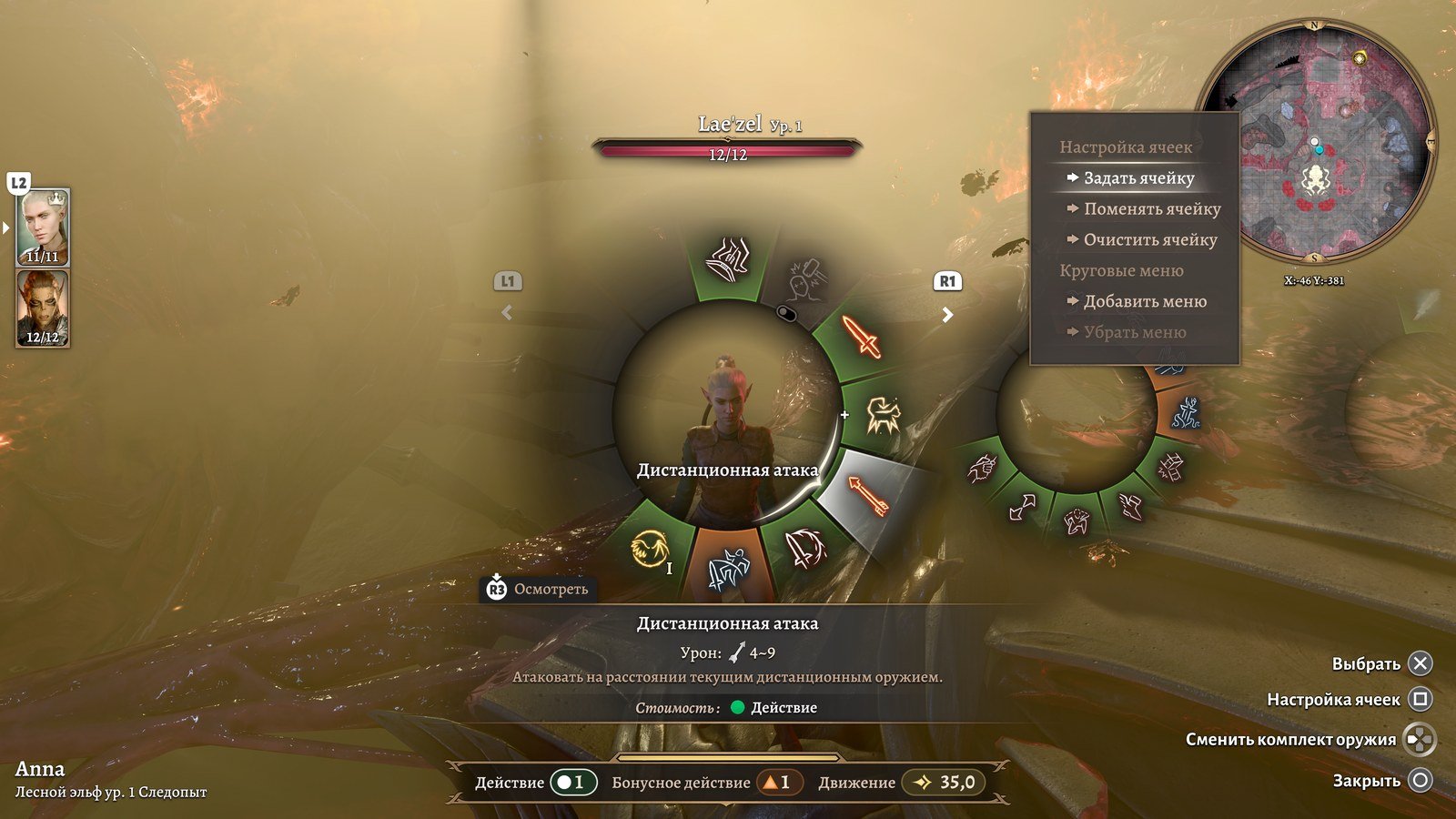
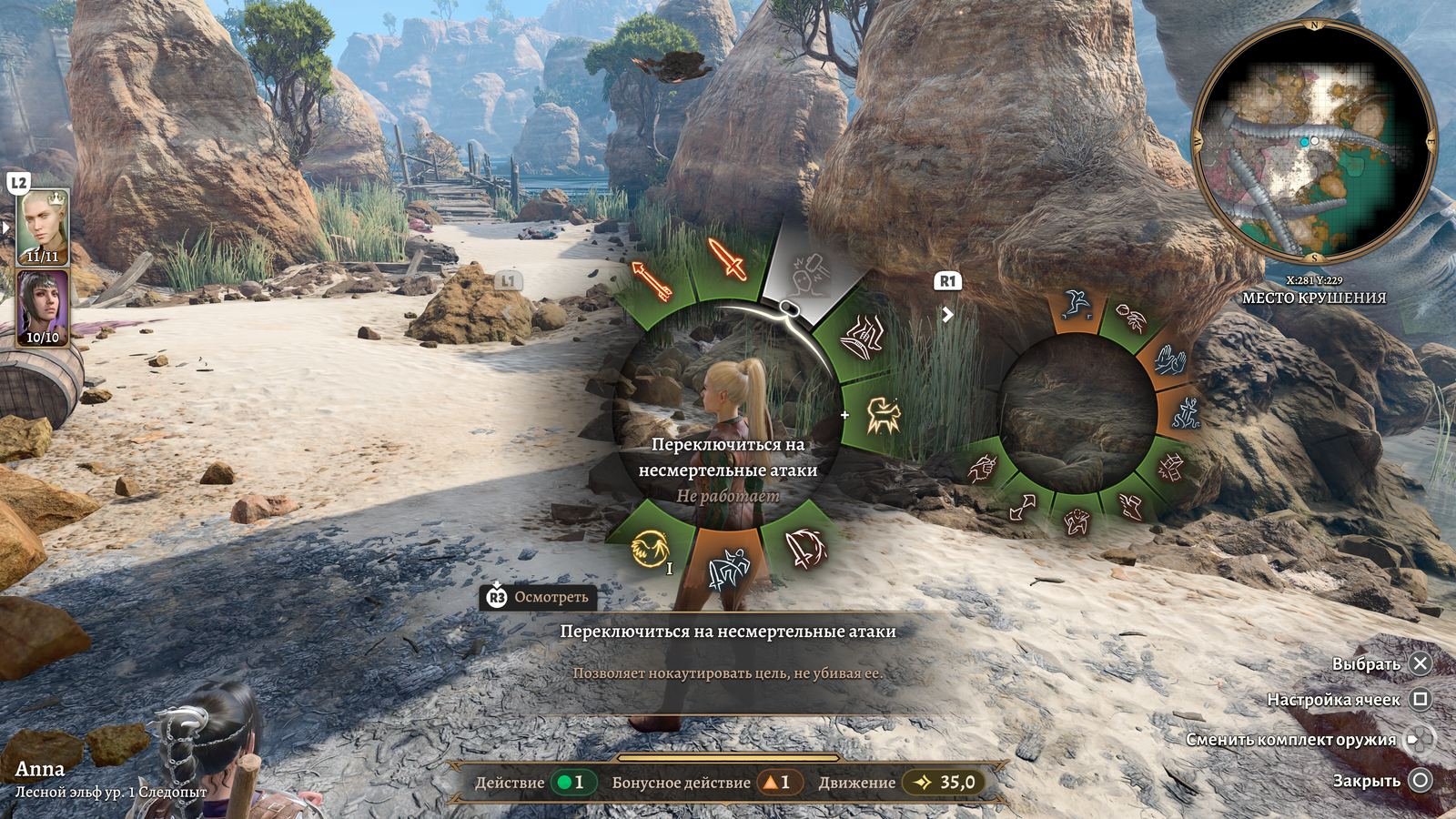
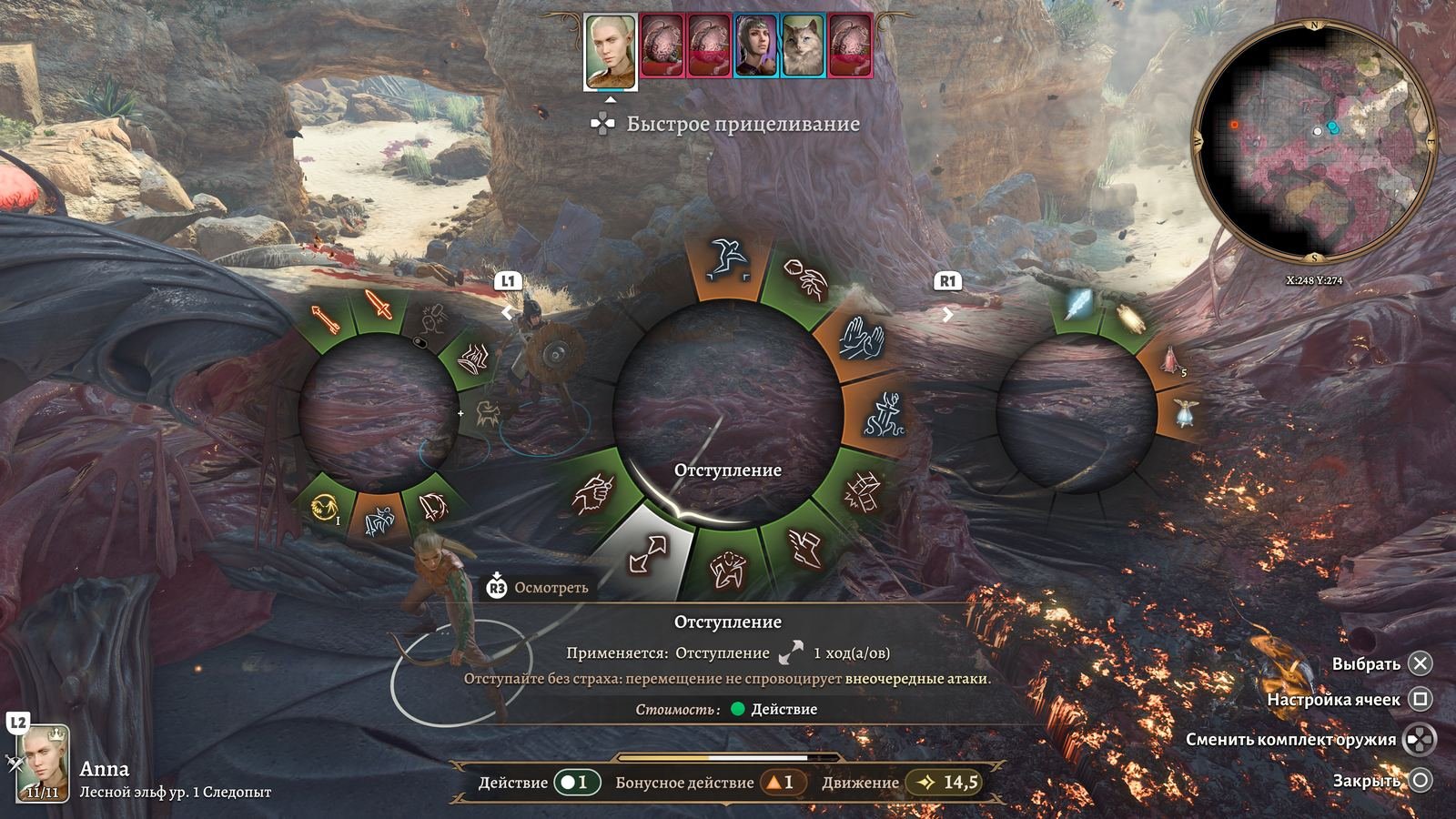
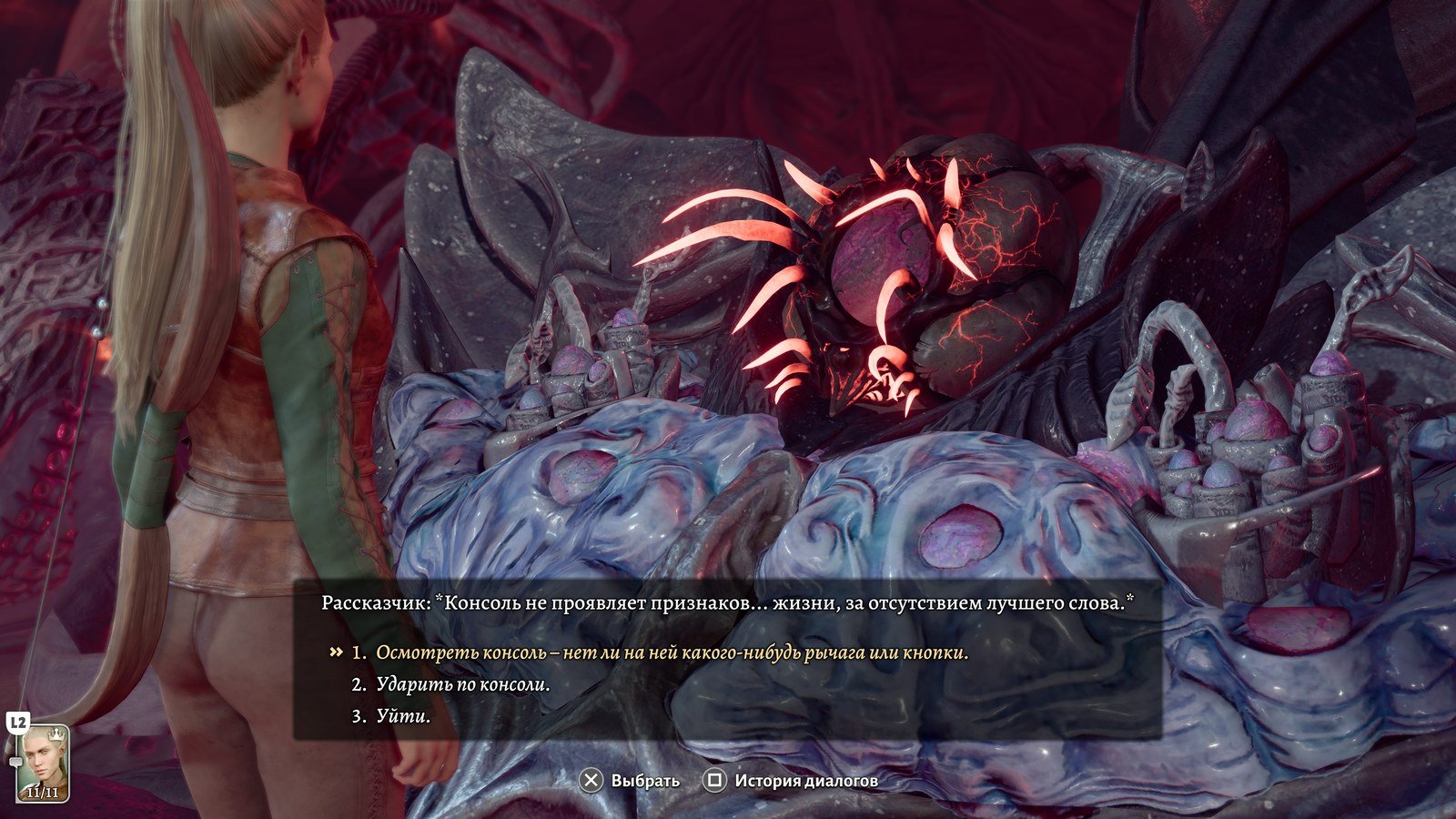
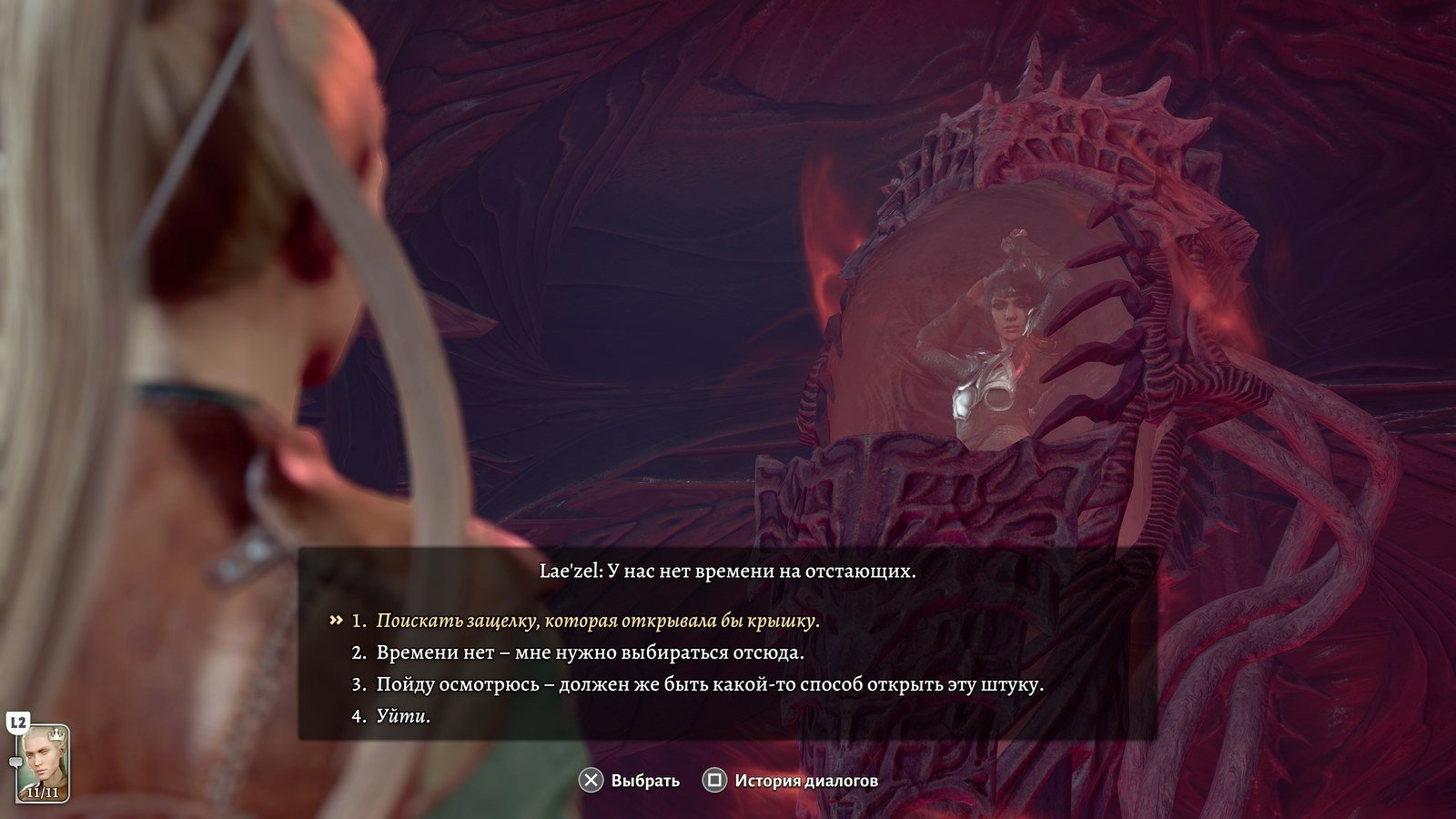
Five in-game screens in three tabs: the radial action wheel with its slot-setup menu, the combat HUD and its turn resources; the non-lethal attack toggle and the disengage action; and two dialogue screens (narration and a companion's line, each with its reply options). Pick a screen, then tap a button to hear the line.
0.90x
Radial Menu & Combat HUD
Character & Status
У́ровень 1
Level 1 (shortened to Ур. on screen)
NOMУ́ровень · Dictionary form (masc., "level"), nominative; Used bare as a status label, printed after the character's name on the health bar.
The game only ever prints the abbreviation Ур. The full word is taught here so the audio pronounces what you actually need to recognise when it is spelled out elsewhere.
Лесно́йэльф, у́ровень 1, Следопы́т
Wood Elf, level 1, Ranger (the character summary under your portrait)
NOMэльф · Dictionary form (masc., "elf"), nominative; The head noun of the race name.
NOMу́ровень · Dictionary form (masc., "level"), nominative; Printed here as the abbreviation ур., the same word taught in full in the entry above.
NOMЛесно́й ("forest/wood") · Agrees with эльф, nominative masc singular; From лес ("forest"), so the race reads literally as "forest elf."
NOMСледопы́т · Dictionary form (masc., "ranger/pathfinder"), nominative; The class name, built from след ("track/trail"), so literally "one who reads tracks."
Следопы́т is also the standard Russian title of Fenimore Cooper's The Pathfinder, which is why it reads as the natural word for a woodland ranger rather than as a coined game term.
Radial Menu Setup
Настро́йкаяче́ек
Slot setup
NOMНастро́йка · Dictionary form (fem., "setting/adjustment"), nominative; From настро́ить ("to adjust/tune"), used bare as a heading.
GENяче́ек · Dictionary яче́йка (fem., "cell/slot"), genitive plural; Possessive after Настро́йка, "setup of the slots."
This label appears twice on this one screen: as the grey heading of the pop-up panel, and again as the button prompt in the bottom-right corner.
Зада́тьяче́йку
Assign a slot
Зада́ть · Infinitive (pf., "to set/assign"); Imperfective partner задава́ть. The same verb sets a task, asks a question and, here, fills a slot.
ACCяче́йку · Dictionary яче́йка (fem., "slot"), accusative singular; Direct object of Зада́ть.
Поменя́тьяче́йку
Swap a slot
Поменя́ть · Infinitive (pf., "to swap/exchange"); Меня́ть ("to change") with the по- prefix, which is what makes it perfective here.
ACCяче́йку · Same accusative direct object as in Зада́ть яче́йку above.
Очи́ститьяче́йку
Clear a slot
Очи́стить · Infinitive (pf., "to clear/empty"); Built on чи́стый ("clean"), so literally "to make clean." Imperfective partner очища́ть.
ACCяче́йку · Same accusative direct object as the two entries above.
Круговы́еменю́
Radial menus
NOMменю́ · Dictionary form (neut., "menu"), nominative plural; An indeclinable loanword: identical in every case and both numbers, so only the adjective shows that this is a plural.
NOMКруговы́е ("circular/radial") · Agrees with меню́, nominative plural; From круг ("circle"). Russian describes this wheel as circular where English calls it radial.
ACCменю́ · Direct object of Доба́вить, accusative; Indeclinable, so the form is identical to the nominative. Only the surrounding words can tell you the case.
Убра́тьменю́
Remove a menu
Убра́ть · Infinitive (pf., "to remove/take away"); Imperfective partner убира́ть, which also covers tidying up a room.
ACCменю́ · Same indeclinable accusative object as in Доба́вить меню́ above.
Printed in grey rather than white here, meaning the option is unavailable: there is only one radial menu configured, so there is nothing to remove.
Action Tooltip
Дистанцио́ннаяата́ка
Ranged attack
NOMата́ка · Dictionary form (fem., "attack"), nominative; Used bare as the name of the action.
NOMДистанцио́нная ("ranged/remote") · Agrees with ата́ка, nominative fem singular; From диста́нция ("distance"). The same adjective covers a remote control and a distance-learning course.
Shown twice on this screen: as the label inside the wheel naming the highlighted slot, and again as the title of the tooltip beneath it.
Уро́н: 4~9
Damage: 4 to 9
NOMУро́н · Dictionary form (masc., "damage/harm"), nominative; Used bare as a stat label, followed by the damage range.
Уро́н is the standard Russian games word for damage dealt in combat. Поврежде́ние, the other candidate, is reserved for physical damage to an object or a vehicle, which is why Arma uses it for a damaged wheel and Baldur's Gate 3 does not use it here.
The tilde in 4~9 is the game's own notation for a range, where English would normally print 4 to 9. The audio reads the label alone, since the numbers are a stat rather than vocabulary.
Атакова́ть на расстоя́ниитеку́щимдистанцио́ннымору́жием
Attack at range with your current ranged weapon.
Атакова́ть · Infinitive ("to attack"); Biaspectual: this one form serves as both the imperfective and the perfective, so no aspect partner exists.
PREPрасстоя́нии · Dictionary расстоя́ние (neut., "distance"), prepositional singular; Object of на, giving the fixed phrase на расстоя́нии, "at a distance."
INSору́жием · Dictionary ору́жие (neut., "weapon"), instrumental singular; The bare instrumental of means, "with a weapon," which needs no preposition at all.
INSтеку́щим ("current") · Agrees with ору́жием, instrumental neut singular; Originally the present participle of течь ("to flow"), long since fixed as the everyday word for "current."
INSдистанцио́нным ("ranged") · A 2nd modifier stacked on the same noun, also instrumental neut singular.
Сто́имость: Де́йствие
Cost: Action
NOMСто́имость · Dictionary form (fem., "cost"), nominative; An abstract noun built from сто́ить ("to cost") with -ость, an ending that always produces a feminine soft-sign noun.
NOMДе́йствие · Nominative, naming what this action costs; Taught in full as a turn resource in the group below.
Turn Resources
Де́йствие
Action (one per turn)
NOMДе́йствие · Dictionary form (neut., "action/act"), nominative; From де́йствовать ("to act"), used bare as a label on the turn-resource bar.
The main thing a character spends each turn, held apart from the bonus action beside it. Attacking, casting and dashing all draw on this one.
Бо́нусноеде́йствие
Bonus action
NOMде́йствие · Same neuter noun as above, nominative.
NOMБо́нусное ("bonus") · Agrees with де́йствие, nominative neut singular; A loanword root, бо́нус, fitted with the native adjective ending -ный so that it can decline normally.
Движе́ние
Movement (metres left this turn)
NOMДвиже́ние · Dictionary form (neut., "movement/motion"), nominative; A verbal noun from дви́гать ("to move"). The same word means road traffic on a street sign.
The 35,0 printed beside it is a distance in metres. Russian writes a decimal comma where English writes a decimal point, so this is thirty-five, not thirty-five thousand.
Control Prompts
Осмотре́ть
Examine
Осмотре́ть · Infinitive (pf., "to examine/inspect"); Смотре́ть ("to look") with the о- prefix, which adds "all around," so literally "to look over." Imperfective partner осма́тривать.
This is the verb a doctor uses for examining a patient, and the one a customs officer uses for inspecting your bags. Its reflexive form осмотре́ться turns up on the third screen of this page.
Вы́брать
Select
Вы́брать · Infinitive (pf., "to choose/select"); Брать ("to take") with вы- ("out"), so literally "to take out" of a set. Imperfective partner выбира́ть.
Stress sits on the вы- prefix, as it does in nearly every perfective вы- verb. This is the prompt on the X button, and it appears on all three screens covered by this page.
Смени́тькомпле́ктору́жия
Switch weapon set
Смени́ть · Infinitive (pf., "to change/switch"); Imperfective partner сменя́ть. Related to поменя́ть in the slot-setup menu above, both built on меня́ть.
ACCкомпле́кт · Dictionary form (masc., "set/kit"), accusative; Direct object of Смени́ть, spelled identically to the nominative because it is inanimate.
GENору́жия · Dictionary ору́жие (neut., "weapon"), genitive singular; Possessive after компле́кт, "a set of weaponry." Ору́жие is a collective noun, so the singular covers a whole arsenal.
Закры́ть
Close
Закры́ть · Infinitive (pf., "to close/shut"); Imperfective partner закрыва́ть. Its opposite, откры́ть, appears twice on the third screen of this page.
Non-Lethal Attacks
Non-Lethal Toggle
Переключи́ться на несмерте́льныеата́ки
Switch to non-lethal attacks
Переключи́ться · Infinitive (pf., "to switch over"); Imperfective partner переключа́ться. The non-reflexive переключи́ть switches something else over, so the -ся is what makes the character switch their own stance.
ACCата́ки · Dictionary ата́ка (fem., "attack"), accusative plural; Object of на. Spelled exactly like the nominative plural, because the noun is inanimate.
ACCнесмерте́льные ("non-lethal") · Agrees with ата́ки, accusative plural; Built up in three steps from смерть ("death"): смерте́льный ("lethal"), then не- for the negative.
На plus the accusative marks the endpoint you are switching onto, the same sense as in переключи́ться на другу́ю те́му, "to change the subject."
Не рабо́тает
Not available (literally "does not work")
рабо́тает · Рабо́тать (impf., "to work/function"), 3rd-person singular present; Used with no subject at all, so it reads as "this does not work" rather than naming what does not.
The grey italic line under a wheel slot, meaning the option is unavailable right now, not that anything is broken. The same verb covers a person working, a machine running, and a shop being open.
Позволя́етнокаути́роватьцель, не убива́яеё
Lets you knock the target out without killing it.
Позволя́ет · Позволя́ть (impf., "to allow/permit"), 3rd-person singular present; Perfective partner позво́лить. Subjectless again, the way tooltip text on this page usually is: the sense is "this action allows."
нокаути́ровать · Infinitive ("to knock out"); A loan from the English "knockout" fitted with -ировать, the ending Russian uses to naturalise a borrowed verb. Biaspectual, so this one form serves as both aspects.
ACCцель · Dictionary form (fem., "target/goal"), accusative singular; Direct object of нокаути́ровать. A feminine soft-sign noun, so its accusative is spelled exactly like its nominative.
убива́я · Imperfective gerund of убива́ть ("to kill"), so literally "while killing"; Negated, it becomes "without killing." Russian has no counterpart to the English "without" plus -ing, it uses не plus a gerund instead.
ACCеё · Accusative of она́, standing in for the feminine цель; Object of убива́я. No н- on the front here, because it follows a verb rather than a preposition, unlike the ней on the Narrator screen.
The game prints it without the ё, as ее. The ё is restored here so the audio says /o/ rather than /e/, the same convention the whole site follows.
Map Region
Ме́стокруше́ния
Crash site (the region name above the minimap)
NOMМе́сто · Dictionary form (neut., "place/site"), nominative; Used bare as a map label.
GENкруше́ния · Dictionary круше́ние (neut., "crash/wreck"), genitive singular; Possessive after Ме́сто, "the place of the crash." Built on ру́шить ("to demolish"), so the root idea is a collapse.
The game prints every region name in capitals. That is styling rather than spelling, so the entry gives the phrase in ordinary sentence case.
Disengage
Aim Prompt
Бы́строеприце́ливание
Quick aiming
NOMприце́ливание · Dictionary form (neut., "aiming"), nominative; A verbal noun from прице́ливаться ("to take aim"), itself built on цель, the target taught on the previous screen.
NOMБы́строе ("quick/fast") · Agrees with прице́ливание, nominative neut singular.
Nouns ending in -ание and -ение are all neuter and all name an action rather than a thing, which is why so much of this game's interface is built from them. Three of them appear on this one screen.
Disengage Action
Отступле́ние
Disengage (literally "retreat")
NOMОтступле́ние · Dictionary form (neut., "retreat/withdrawal"), nominative; From отступи́ть ("to step back"), which is ступи́ть ("to step") with от- ("away from").
Shown twice on this screen: as the label inside the wheel naming the highlighted slot, and again as the title of the tooltip beneath it, exactly as Дистанцио́нная ата́ка is on the first screen.
In a military context this is the ordinary Russian word for a retreat. Baldur's Gate 3 uses it for the action English calls Disengage.
Применя́ется: Отступле́ние, 1 ход(а/ов)
Applies: Disengage, 1 turn
Применя́ется · Применя́ться (impf., "to be applied"), 3rd-person singular present; The non-reflexive применя́ть means to apply something. Adding -ся turns it into a passive, which is how Russian most often builds a present passive.
NOMход · Dictionary form (masc., "move/turn"), nominative; The same noun covers a move in chess and a passage or entrance in a building.
ход(а/ов) is the game's own collapsed notation for an agreement it cannot predict in advance: 1 ход, 2 хо́да, 5 ходо́в. English needs only "turn(s)", so Russian prints all three endings at once. The audio reads the singular.
Отступа́йте без стра́ха: перемеще́ние не спровоци́руетвнеочередны́еата́ки
Retreat without fear: your movement will not provoke opportunity attacks.
Отступа́йте · Отступа́ть (impf., "to retreat"), imperative plural; The imperfective partner of the отступи́ть behind Отступле́ние above. An imperfective imperative invites rather than orders, which is what makes this line read as reassurance.
GENстра́ха · Dictionary страх (masc., "fear"), genitive singular; Object of без, which always takes the genitive.
NOMперемеще́ние · Dictionary form (neut., "movement/relocation"), nominative; Subject of спровоци́рует. Not the same word as the Движе́ние on the turn bar: движе́ние is movement as a resource, перемеще́ние is the act of relocating.
спровоци́рует · Спровоци́ровать (pf., "to provoke"), 3rd-person singular; A perfective verb has no present tense, so this present-looking form reads as a future, "will not provoke." The с- prefix is what makes the borrowed провоци́ровать perfective.
ACCата́ки · Dictionary ата́ка (fem., "attack"), accusative plural; Direct object of спровоци́рует. Accusative rather than the genitive that negation can trigger, because a specific outcome is in view; the genitive of negation is largely optional now outside fixed phrases.
ACCвнеочередны́е ("out of turn") · Agrees with ата́ки, accusative plural; Built from вне ("outside") and о́чередь ("queue/turn"), so literally "outside the queue," which is precisely what an opportunity attack is.
Narrator Dialogue
Narrator Line
Расска́зчик: *Консо́ль не проявля́етпри́знаков... жи́зни, за отсу́тствиемлу́чшегосло́ва.*
Narrator: The console shows no signs of... life, for lack of a better word.
NOMРасска́зчик · Dictionary form (masc., "narrator/storyteller"), nominative; From расска́зывать ("to tell/recount"). This is the speaker label on every line of the game's narration.
NOMКонсо́ль · Dictionary form (fem., "console"), nominative; Subject of проявля́ет. A soft-sign loanword that is feminine, so any adjective on it would take a feminine ending.
GENпри́знаков · Dictionary при́знак (masc., "sign/indication"), genitive plural; Genitive rather than accusative because the verb is negated, the standard pattern behind "shows no signs."
GENжи́зни · Dictionary жизнь (fem., "life"), genitive singular; Possessive after при́знаков, "signs of life."
INSотсу́тствием · Dictionary отсу́тствие (neut., "absence"), instrumental singular; Object of за in the bookish fixed phrase за отсу́тствием, "for want of."
GENсло́ва · Dictionary сло́во (neut., "word"), genitive singular; Object of отсу́тствием, "the absence of a word."
GENлу́чшего ("better") · Agrees with сло́ва, genitive neut singular; The comparative of хоро́ший, which is suppletive: it shares no root with the positive form at all.
The asterisks bracketing the line are the game's way of marking narration rather than spoken dialogue. They are typography, not words, so the audio passes over them.
Dialogue Options
Осмотре́тьконсо́ль: нет ли на нейкако́го-нибудьрычага́ и́ли кно́пки
Examine the console to see whether there is any kind of lever or button on it.
Осмотре́ть · The same perfective infinitive taught as the R3 prompt on the first screen, here heading a dialogue choice.
ACCконсо́ль · Dictionary консо́ль (fem., "console"), accusative singular; Direct object of Осмотре́ть. Feminine soft-sign nouns spell their accusative exactly like their nominative.
PREPней · Prepositional of она́, standing in for the feminine консо́ль; Object of на. The н- at the front is added to any 3rd-person pronoun that follows a preposition.
GENрычага́ · Dictionary рыча́г (masc., "lever"), genitive singular; Genitive after the negative existential нет, "there is no lever." Note that the stress moves onto the ending.
GENкно́пки · Dictionary кно́пка (fem., "button"), genitive singular; The second thing governed by that same нет.
GENкако́го-нибудь ("any kind of") · Agrees with рычага́, genitive masc singular; The -нибудь series marks something genuinely unknown, as against -то, which marks something specific that the speaker simply cannot name. Both appear on this page.
Нет ли is an indirect yes-or-no question: the particle ли carries the "whether," which is why no separate word for it appears.
DATконсо́ли · Dictionary консо́ль (fem.), dative singular; Object of по. Уда́рить по plus dative is striking at a surface, where a plain accusative object would mean hitting a person.
Уйти́
Leave.
Уйти́ · Infinitive (pf., "to leave/go away"); Идти́ ("to go on foot") with the у- prefix, which carries "away from." Imperfective partner уходи́ть.
The standard way out of any conversation, and it appears as the last numbered option on both dialogue screens covered by this page.
Dialogue Controls
Исто́риядиало́гов
Dialogue history
NOMИсто́рия · Dictionary form (fem., "history/story"), nominative; Used bare as a button label. The same word covers history as a subject and a story you tell.
GENдиало́гов · Dictionary диало́г (masc., "dialogue"), genitive plural; Possessive after Исто́рия, "a history of the dialogues."
Sits beside Вы́брать along the bottom of both dialogue screens.
Companion Dialogue
Companion Line
У нас нет вре́мени на отстаю́щих
We have no time for stragglers.
GENнас · Genitive of мы ("we"); Object of у in the у кого́ есть possession frame, here in its negated form, у нас нет.
GENвре́мени · Dictionary вре́мя (neut., "time"), genitive singular; Genitive after нет. Вре́мя is one of the ten neuter -мя nouns that insert -ен- in every case except the nominative and accusative.
ACCотстаю́щих · Present active participle of отстава́ть ("to lag behind") used as a noun, accusative plural; Object of на. Animate, so its accusative copies the genitive. Literally "those who lag," which English calls stragglers.
Dialogue Options
Поиска́тьзащёлку, кото́раяоткрыва́ла бы кры́шку
Look for a latch that would open the lid.
Поиска́ть · Infinitive (pf., "to look for a while"); Иска́ть ("to search") with по-, which here adds "spend a bounded stretch of time on it," a very common Russian way of framing an activity.
ACCзащёлку · Dictionary защёлка (fem., "latch/catch"), accusative singular; Direct object of Поиска́ть. The game prints it without the ё, as защелку; the ё is restored here so the audio says /o/ rather than /e/.
NOMкото́рая · Relative pronoun ("which/that"), nominative fem singular; It takes its gender and number from защёлку but its case from its own clause, where it is the subject.
открыва́ла · Открыва́ть (impf., "to open"), past tense feminine; Feminine because it agrees with кото́рая, which stands for защёлку.
бы · The conditional particle; Past tense plus бы is the entire Russian conditional. There is no separate subjunctive form, so this reads "would open," never "was opening."
ACCкры́шку · Dictionary кры́шка (fem., "lid/cover"), accusative singular; Direct object of открыва́ла.
Вре́мени нет. Мнену́жновыбира́ться отсю́да
There is no time, I need to get out of here.
GENВре́мени · Genitive after нет, the same negative existential as in Lae'zel's line above; Fronted here for emphasis, where she put у нас first.
DATмне · Dative of я ("I"); The person under an obligation goes in the dative in an impersonal ну́жно clause, never the nominative. There is no grammatical subject at all.
ну́жно · Short neuter form of ну́жный ("necessary"), used impersonally, "it is necessary."
выбира́ться · Infinitive (impf., "to get out/make one's way out"); The -ся here is not literally reflexive: it turns выбира́ть ("to choose/pick out") into the sense of extracting yourself by effort.
отсю́да · "From here" (adverb), the counterpart of сюда́ ("to here") and здесь ("here").
Пойду́осмотрю́сь: до́лжен же бытькако́й-тоспо́соботкры́тьэ́тушту́ку
I will go and look around, there must be some way to open this thing.
Пойду́ · Пойти́ (pf., "to set off"), 1st-person singular; A perfective verb has no present tense, so this present-looking form always reads as a future, "I will go."
осмотрю́сь · Осмотре́ться (pf., "to look around"), 1st-person singular future; The -ся turns the осмотре́ть taught on the first screen from "examine something" into "look about oneself."
до́лжен · Short adjective ("must/ought"), masculine; It agrees with спо́соб, not with the speaker, which is why it is masculine no matter who says the line.
же · An emphatic particle with no English equivalent of its own; It adds insistence, turning "there must be a way" into "there simply must be a way."
быть · Infinitive ("to be"); Russian drops быть in the present tense, so seeing it written means it is carrying something else, here the modal до́лжен.
NOMспо́соб · Dictionary form (masc., "way/method"), nominative; Subject of быть, and the word до́лжен agrees with.
NOMкако́й-то ("some") · Agrees with спо́соб, nominative masc singular; The -то series points at something definite that the speaker cannot name, unlike the -нибудь of како́го-нибудь on the previous screen.
откры́ть · Infinitive (pf., "to open"); Complement of спо́соб, "a way to open." The opposite of the закры́ть taught on the first screen.
ACCшту́ку · Dictionary шту́ка (fem., "thing/item"), accusative singular; Direct object of откры́ть. Colloquial when used of an object whose real name you do not know, exactly as English reaches for "thing."
ACCэ́ту ("this") · Agrees with шту́ку, accusative fem singular.