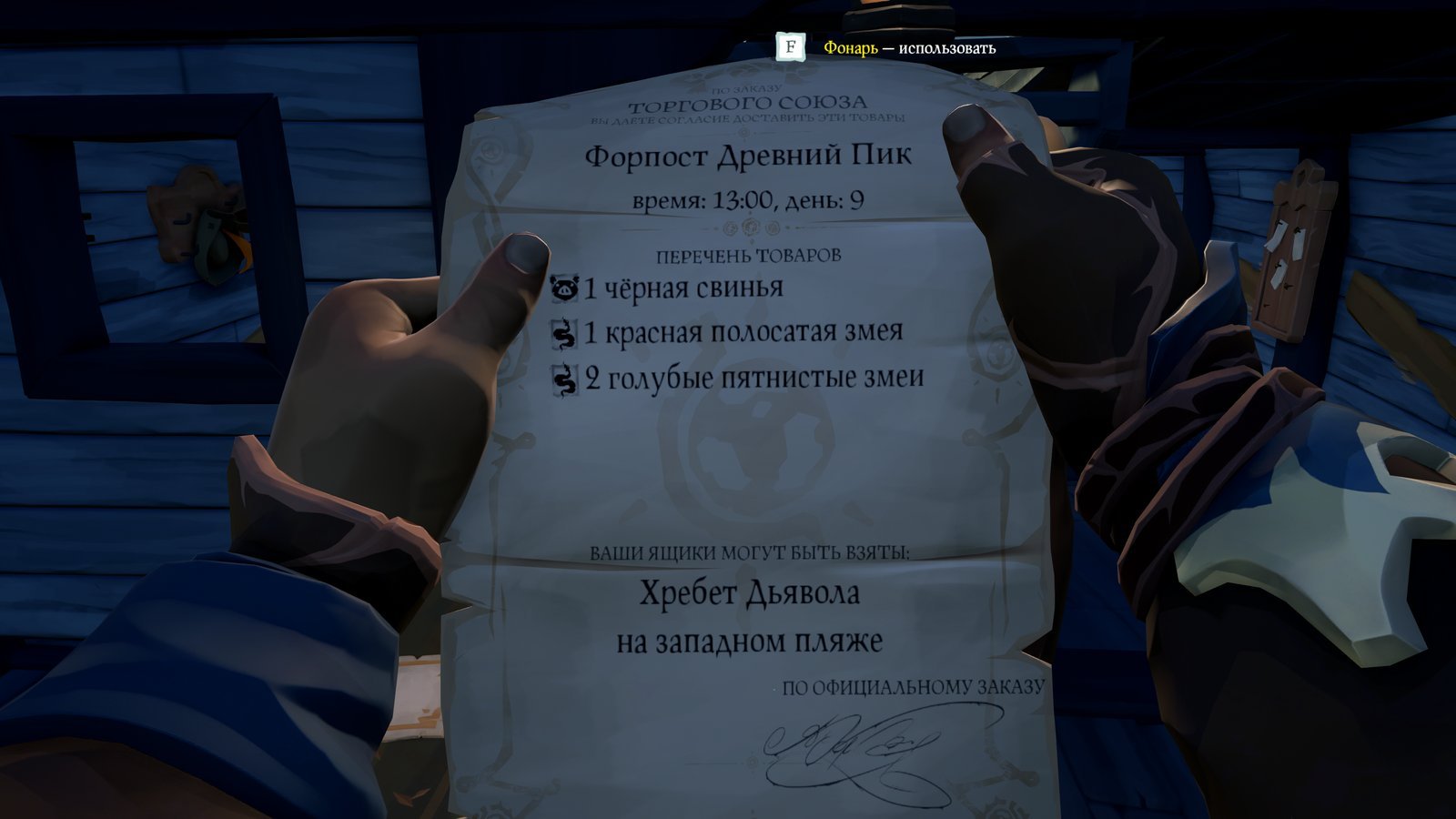
At the outpost: a Merchant Alliance delivery order, and a shopkeeper's greeting with your reply options. Tap the button to hear it.
0.90x
Merchant Alliance Delivery Order
HUD Prompt
Фона́рь: испо́льзовать
Lantern: use (top-of-screen prompt)
NOMФона́рь · Dictionary form (masc., "lantern"), nominative; Used bare as the item-name half of the prompt.
испо́льзовать · Infinitive (impf., "to use"); The action half of the prompt. The game's F-key prompts all name the item, then the verb; the game separates the two with a dash, written here as a colon.
Order Header
По зака́зуТорго́вогосою́за
By order of the Merchant Alliance
DATзака́зу · Dictionary зака́з (masc., "order/commission"), dative singular; Object of по ("by/on"), a fixed document-heading construction, "by order of..."
GENсою́за · Dictionary сою́з (masc., "union/alliance"), genitive singular; Possessive, "of the Union" (the in-game Merchant Alliance faction).
GENТорго́вого ("trade/commercial") · Agrees with сою́за, genitive masc singular.
Выдаётесогла́сиедоста́витьэ́титова́ры
You agree to deliver these goods
NOMВы · Personal pronoun, nominative ("you", formal/plural); Subject of даёте.
ACCсогла́сие · Dictionary согла́сие (neut., "consent/agreement"), accusative; Direct object of даёте, "give consent."
доста́вить · Infinitive (pf., "to deliver"); Complement of согла́сие, explaining what the consent is for.
ACCтова́ры · Dictionary това́р (masc., "goods"), accusative plural; Direct object of доста́вить.
ACCэ́ти ("these") · Agrees with това́ры, accusative plural.
Форпо́ст Дре́вний Пик
Ancient Spire Outpost (the delivery destination)
NOMФорпо́ст · Dictionary form (masc., "outpost"), nominative; Used bare as a document heading naming the delivery destination.
Дре́вний Пик · The outpost's own proper name ("Ancient Spire"), the same appositive pattern as on the Trading page's Форпо́сте Дре́вний Пик entry: the generic noun declines, the name itself doesn't.
Вре́мя: 13:00, день: 9
Time: 13:00, Day: 9
NOMВре́мя · Dictionary вре́мя (neut., irregular declension), nominative; Used bare as a document label ("time:"), followed by the clock time.
NOMдень · Dictionary день (masc., "day"), nominative; Used bare as a document label ("day:"), followed by the in-game day count.
Goods Manifest
Пе́реченьтова́ров
Goods Manifest (section heading)
NOMПе́речень · Dictionary form (masc., "list"), nominative; Used bare as a section heading.
NOMсвинья́ · Dictionary form (fem., "pig"), nominative singular; Counted with 1 (одна́), which takes plain nominative singular.
NOMчёрная ("black") · Agrees with свинья́, nominative fem singular.
1 кра́снаяполоса́таязмея́
1 red striped snake
NOMзмея́ · Dictionary form (fem., "snake"), nominative singular.
NOMкра́сная ("red") · Agrees with змея́, nominative fem singular.
NOMполоса́тая ("striped") · A 2nd modifier stacked on the same noun, also nominative fem singular.
2 голубы́епятни́стыезмеи́
2 blue spotted snakes
GENзмеи́ · Dictionary змея́ (fem., "snake"), genitive singular; Numerals 2/3/4 take a genitive-singular noun (unlike 5+, which take genitive plural).
NOMголубы́е ("blue"), пятни́стые ("spotted") · Nominative plural, not genitive; A quirk of Russian numeral agreement: with 2/3/4 and a feminine noun, the noun itself goes genitive singular but its adjectives go nominative plural instead.
NOMВа́ши ("your") · Agrees with я́щики, nominative plural.
мо́гут быть взя́ты · Мочь (impf., "can/to be able"), 3rd-person plural, plus the short-form passive participle of взять (pf., "to take"); A modal-plus-passive-infinitive construction meaning "can be taken/picked up."
Хребе́тДья́вола, на за́падномпля́же
Devil's Ridge, on the western beach
NOMХребе́т · Dictionary form (masc., "ridge"), nominative; Part of the location's own proper name, "Devil's Ridge."
GENДья́вола · Genitive of Дья́вол ("Devil's"), possessive; Modifies Хребе́т, fixed as part of the place name.
PREPпля́же · Dictionary пляж (masc., "beach"), prepositional singular; Object of на, location "on the beach."
PREPза́падном ("western") · Agrees with пля́же, prepositional masc singular.
По официа́льномузака́зу
By official order (footer)
DATзака́зу · Same по + dative construction as По зака́зу above, "by order."
DATофициа́льному ("official") · Agrees with зака́зу, dative masc singular.
Shopkeeper Dialogue
Shopkeeper's Greeting
Да, яТим. И чего́вамна́до?
Yes, I'm Tim. And what do you need?
Да · Interjection ("Yes"), a bare affirmative before continuing the sentence.
NOMя · Personal pronoun, nominative ("I"); Subject of the implied "am" (Russian drops the present-tense copula быть).
NOMТим · Predicate name, nominative; The shopkeeper's own name, kept as its Cyrillic transliteration rather than translated.
GENчего́ · Genitive of что ("what"), a colloquial variant of "Что вам надо?"; Common in casual or gruff spoken registers, fitting the shopkeeper's brusque tone.
DATвам · Dative of вы ("you", formal/plural); Experiencer of на́до, the impersonal "you need" construction (dative subject + indeclinable на́до).
на́до · Indeclinable predicate word ("need to/must"), governs the dative experiencer вам.
Dialogue Options
Посмотре́тьтова́ры в ла́вкеТи́ма
Look at the goods in Tim's shop (highlighted/default option)
Посмотре́ть · Infinitive (pf., "to look at/take a look at"); The highlighted default dialogue option in this exchange.
ACCтова́ры · Dictionary това́р (masc., "goods/merchandise"), accusative plural; Direct object of Посмотреть.
PREPла́вке · Dictionary ла́вка (fem., a folksy/dated word for "shop/stall"), prepositional singular; Object of в, location "in Tim's shop."
GENТи́ма · Genitive of Тим ("Tim's"), possessive; Modifies ла́вке.
Как дела́?
How are you? / How's it going?
NOMдела́ · Dictionary де́ло (neut., "affair/matter"), nominative plural; Idiomatic greeting with Как ("how"), literally "how [are] affairs," equivalent to "How's it going?"
Чтовымнепосове́туете?
What would you recommend to me?
ACCЧто · Interrogative pronoun, accusative ("what", same form as nominative, inanimate); Direct object of посоветуете.
NOMвы · Personal pronoun, nominative ("you", formal/plural); Subject of посоветуете.
DATмне · Dative of я ("I"), indirect object ("to me").
Have you been working at Ancient Spire Outpost for a long time?
NOMВы · Personal pronoun, nominative ("you", formal/plural); Subject of рабо́таете.
рабо́таете · рабо́тать (impf., "to work"), 2nd-person plural/formal present tense; Paired with давно́ ("for a long time"), Russian uses the present tense where English uses "have been working."
PREPФорпо́сте · Dictionary Форпо́ст (masc., "outpost"), prepositional singular; Object of на, location "at the Outpost."
Дре́вний Пик · The outpost's own name ("Ancient Spire"), stays nominative as an appositive to Форпосте rather than declining with it; The same pattern as "в го́роде Москва́" ("in the city of Moscow"), where the generic noun declines but the proper name doesn't.